Manufacturing Facility Roofing in Kansas City, MO
Commercial roofing for manufacturing plants, assembly facilities, and industrial buildings throughout Kansas City, MO.
Hallmark Cards, whose Crown Center campus and corporate printing and manufacturing facilities have anchored Kansas City's industrial identity for over a century, operates some of the most sophisticated commercial printing and manufacturing buildings in the region. The combination of large-format printing equipment, chemical-intensive ink and dye processes, and the company's commitment to its historic corporate campus creates commercial roofing requirements that parallel those of a pharmaceutical or specialty chemicals manufacturer. Beyond Hallmark, Kansas City's manufacturing sector includes General Motors' Fairfax Assembly plant in Kansas City, Kansas, Ford's Claycomo truck assembly facility, and a dense network of food processing, packaging, and aerospace suppliers whose combined roofing demands define the standards of the local commercial roofing market.
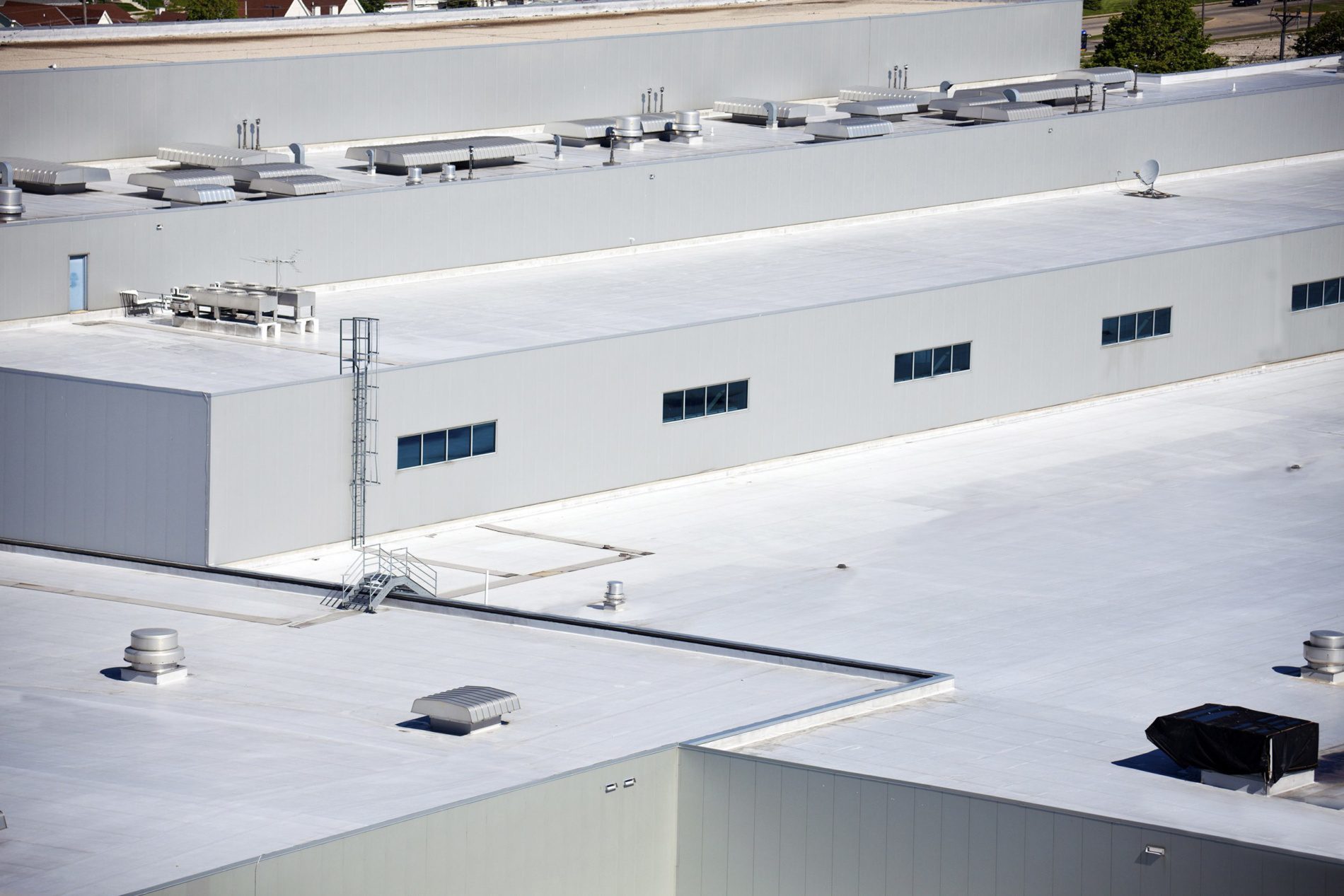
Process equipment on Kansas City manufacturing roofs reflects the city's industrial diversity. At automotive assembly facilities, robotic welding ventilation, paint booth exhaust towers, and automated conveyor system supports penetrate the roof at hundreds of locations. At food processing and packaging plants, refrigeration condenser arrays, grain handling vents, and product dryer exhaust stacks create equipment landscapes that require detailed mechanical coordination. At printing operations like Hallmark's, ink solvent recovery systems, UV curing exhaust units, and climate control systems maintaining paper storage conditions all demand specific curb and flashing designs. No two Kansas City manufacturing roofs are identical in their equipment profile.
Chemical fume exposure in Kansas City's manufacturing sector spans one of the widest ranges of any major industrial market. Automotive paint chemistry, food processing cleaning compounds, printing solvents, and aerospace coating materials are all present in the Kansas City metro area. The contractor's specification process must be based on chemical identification at the facility level, with membrane compatibility verified against the specific compounds documented in the facility's SDS library or air emissions inventory. Applying a generic industrial membrane specification across different facility types without chemical compatibility verification is a common error that leads to premature membrane failure.
Vibration management at Kansas City automotive assembly plants requires analysis of the specific production zone underlying each roof section. Stamping presses at the Fairfax and Claycomo facilities produce vibration that is orders of magnitude greater than the conveyor and assembly equipment in the main assembly areas. Roof sections over stamping operations should be designed with fully adhered membrane systems, and the perimeter securement details should account for the possibility of seismic ground motion on top of the continuous production vibration. Kansas City sits near the New Madrid Seismic Zone, and roofing specifications for long-life industrial applications should incorporate appropriate seismic detailing at parapet and equipment connections.
Skylight strategy at Kansas City manufacturing facilities must balance daylighting value against Missouri's climate extremes. Winter heating loads are significant at KC latitudes, and a skylight that delivers good daylighting but poor thermal performance can add measurably to the facility's heating costs. When skylights are replaced as part of a re-roof, double-dome or triple-glazed units with low-conductivity frames provide meaningfully better thermal performance than single-dome replacements. The energy savings over the replacement skylight's service life should be quantified as part of the re-roof investment justification.
Roof drain management on Kansas City manufacturing roofs must account for the region's occasional severe thunderstorm events, which can deliver several inches of rainfall in a short period. The 100-year storm intensity for the Kansas City area is among the higher values in the central United States. Many older industrial buildings in the metro area were designed to older drainage standards that may not reflect current code requirements. The contractor's drainage assessment should verify that every drain and overflow system is adequate to handle the current design rainfall intensity and that no sections of the roof have lost slope to structural deflection over time.
Production schedule coordination at Kansas City automotive plants requires integration with the OEM's production planning calendar. GM and Ford both run production schedules that are published months in advance, and model changeover periods, which typically occur in late summer, represent the best opportunity for major construction activity on the plant roof. The contractor must be on the facility's annual maintenance planning calendar at least six months before the intended construction window, and the project scope must be approved through the plant's capital project review process before mobilization authorization is granted.
Kansas City's commercial roofing climate presents a full range of seasonal challenges. Summers are hot and humid, limiting the application windows for temperature-sensitive adhesives. Winters are cold, with significant freeze-thaw cycling that stresses membrane seams and lap joints. Spring and fall offer the best working conditions, but spring rain and fall wind events can interrupt progress. The project schedule should include appropriate weather contingency days based on historical data for the Kansas City area, not the national average, and the contractor should have an established relationship with a membrane manufacturer technical representative who can be consulted when application conditions are marginal.
A commercial roofing contractor serving Kansas City manufacturers should be able to demonstrate specific experience with OEM-tier automotive facilities, documented New Madrid Seismic Zone detailing knowledge, and references from industrial clients in the metro area whose facility types match the target project. Pre-qualification processes at Kansas City's largest manufacturers are rigorous; contractors who haven't prepared their safety documentation and insurance certificates to the standards expected by a tier-one OEM supplier will be disqualified before their pricing is ever reviewed.
- How does the New Madrid Seismic Zone affect commercial roofing specifications at Kansas City manufacturing facilities?
- Kansas City's proximity to the New Madrid Seismic Zone means that long-life industrial roofing specifications should incorporate seismic detailing at parapet connections and equipment curbs. The combination of continuous production vibration and potential seismic ground motion makes robust perimeter securement and flexible equipment connections important design elements.
- What is the best scheduling window for a major re-roof at a Kansas City automotive assembly plant?
- Model changeover periods, typically occurring in late summer, represent the best opportunity for major construction activity. The contractor must be on the plant's annual maintenance planning calendar at least six months in advance, and project scope must be approved through the capital project review process before mobilization.
- How should drain capacity be evaluated for an older Kansas City industrial building?
- The contractor should verify that every drain and overflow system meets current design rainfall intensity standards for the Kansas City area, which are among the higher values in the central United States. Structural deflection over time can reduce roof slope, and any section with inadequate slope should be addressed with tapered insulation during the re-roof.
- What chemical identification process should precede membrane selection at a Kansas City manufacturing facility?
- The contractor should obtain the facility's SDS library or air emissions inventory and use it to identify the specific compounds present at each roof section before specifying a membrane. Generic industrial membrane specifications applied without chemical compatibility verification lead to premature failure in chemically aggressive environments.
- What contractor qualifications matter most for Kansas City OEM-tier automotive re-roofs?
- Safety documentation compliant with OEM pre-qualification standards, verifiable references from comparable automotive manufacturing facilities, and insurance certificates meeting OEM carrier requirements are the minimum qualifications. Contractors without OEM-tier industrial experience are typically disqualified during pre-qualification before pricing review.
Ready to talk through a roof?
Tell us about the building and the roof problem. We'll document it and put a plan in writing, with an honest repair-vs-replace recommendation and no upsell pressure.
Get a Roof Assessment →