
Solar-Ready Commercial Roofing & PV Integration in Kansas City, MO
Solar roof integration in Kansas City, MO. We handle PV racking penetrations, membrane compatibility, ballast loads, wind uplift, and warranty coordination so your roof and array last together.
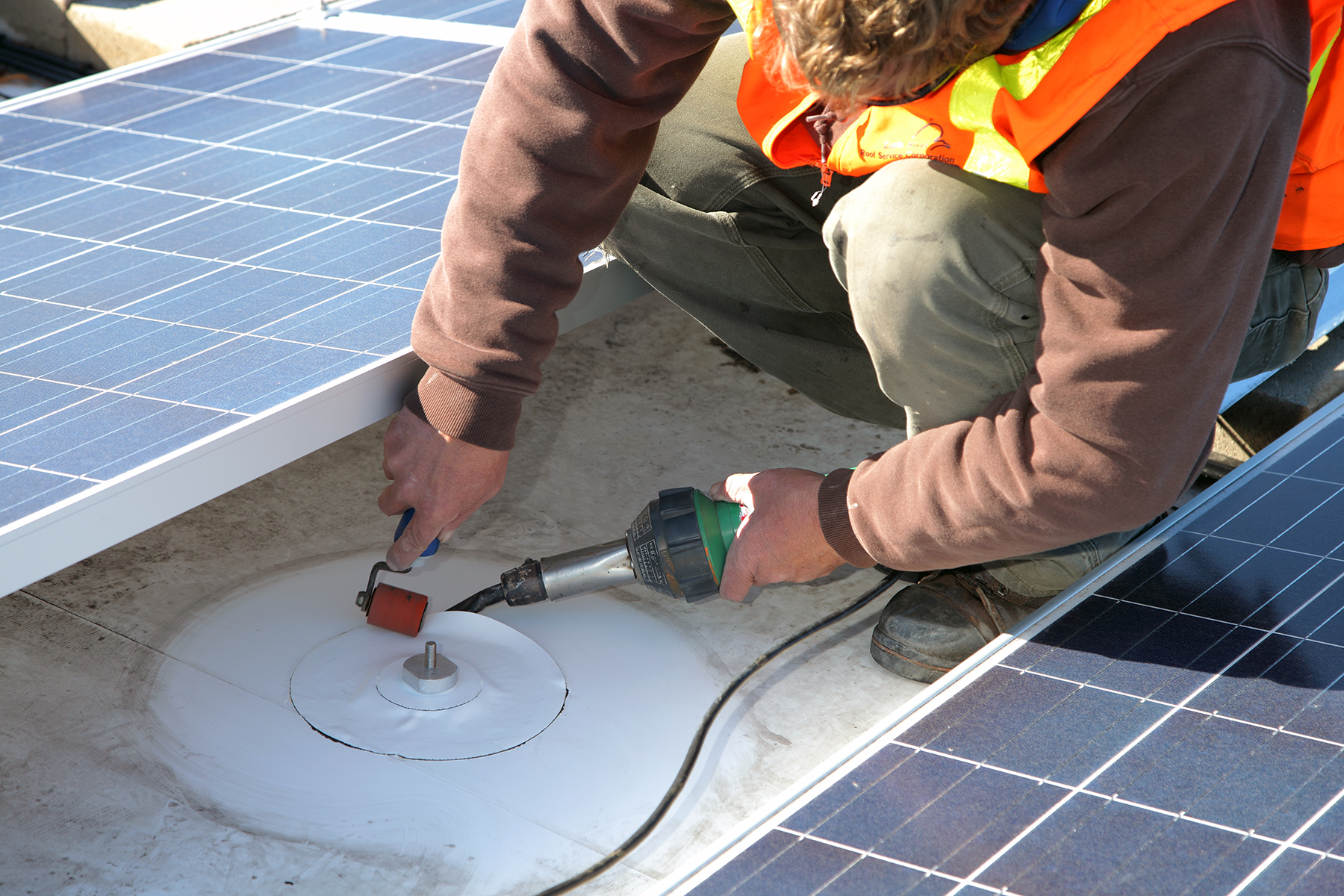
Ask any Kansas City building owner who put solar on an old roof and they will tell you the same thing: the panels were the easy part. We are the roofing side of those projects, and our whole focus is the membrane the array sits on. Across the warehouse rows feeding the I-435 logistics ring, the rehabbed industrial space in the Crossroads, and the office and institutional buildings out toward the College Boulevard corridor in Overland Park, we make sure the roof under the racking is sound, sealed at every attachment, and still carrying a warranty nobody quietly canceled during the solar install.
The roof outlives the lease but not always the array
A rooftop PV system is designed to generate power for a quarter century or more. A commercial membrane in this market might have three years of life left or twenty, depending on when it went down and how it has held up. When those two clocks are out of sync, the owner ends up paying for the mismatch. If the membrane fails under a six-year-old array, every panel, rail, and ballast block has to come off, the roof gets replaced, and the entire system goes back up. That detach-and-reset cycle routinely adds a five-figure sum to a reroof, and it is the single most preventable cost in commercial solar.
So before a solar contract gets signed, we core the roof. We pull samples, look at the membrane and the insulation underneath, and tell you in plain numbers how much service life is realistically left. If there is comfortably more life than the array needs, you build on what you have. If it is marginal or short, the math almost always favors reroofing first, or folding the reroof and the solar mobilization into one job so the roof is only staged once.
Penetrations: where ballast ends and flashing begins
Most low-slope roofs around the metro carry ballasted racking, where weighted trays pin the array down without cutting the membrane. That keeps holes to a minimum, but it loads the structure, which is its own conversation below. When ballast is not an option, because the building cannot carry the weight or the wind exposure is too severe, the racking gets mechanically anchored, and every anchor foot is a hole punched through your waterproofing.
We detail each of those anchors the way we would any roof penetration: a welded or sealed flashing built for the specific membrane chemistry, not a bead of caulk the solar crew left behind on their way out. Conduit gets the same discipline. The DC and AC runs drop from the array into the building's electrical room through one or more roof points, and conduit strapped flat to the membrane saws at it over time while a generic pipe boot becomes next spring's leak. We map the conduit route with the electrical contractor ahead of time and build real curbs, pitch pockets, or molded flashings sized to the penetrations that are actually going in.
Weight and wind: what the deck has to carry
Ballasted arrays add dead load, often several pounds per square foot once trays, modules, and ballast are tallied. On a mid-century building framed to lighter code, that load has to be checked against structural capacity before the first block lands, which usually pulls the building's structural engineer into the project. Wind uplift matters just as much here. Kansas City sits where powerful straight-line winds and the leading edge of spring severe weather regularly arrive, and an array that is under-ballasted or set wrong can lift, slide, or scour the membrane in a single event. The racking layout, the ballast distribution, and any mechanical anchoring all get designed for the building's real wind exposure, with the perimeter and the corners, where uplift peaks, ballasted heavier than the field.
Not every membrane belongs under an array
The membrane choice changes how well an array performs and how long the assembly lasts. A white reflective TPO or PVC is the usual pick in this region: the bright surface runs cooler, which gives panel output a small lift, and both weld into continuous seams that shrug off the foot traffic of install and maintenance crews. Slip pads and walk pads protect the sheet at every bearing point and along the service routes. Where the structure cannot take ballast weight, a fully adhered system erases the load question altogether. What we will not do is set racking on a brittle, sun-baked, already-patched membrane and stamp it solar-ready, because that roof fails under the array and the owner pays for the reset.
Two warranties that have to agree
This is where projects quietly fall apart. The major membrane manufacturers will hold your roof warranty through a solar install, but only if the work follows their playbook: approved ballast pads, approved walkway protection, approved penetration details, and in most cases a pre-installation review by their field representative. When the solar crew installs first and asks permission later, the manufacturer can decline to warrant the roof, and you are left with two separate warranties that point fingers at each other the day water shows up inside.
We run that manufacturer review as part of the project, document every approved detail, and make sure the roof clears its final inspection so the warranty registers cleanly next to the solar system's own coverage. We do not sell PV arrays. That means our only interest in the project is the roof, and we will tell you straight when a building is not a good candidate for solar at all.
How a solar-plus-roofing job runs with us
- Core the existing roof and report remaining service life before any solar contract is signed.
- Verify structural capacity for ballast loads with the building's engineer wherever the load is in question.
- Confirm membrane chemistry and condition, and specify protection at every bearing point and walk path.
- Map conduit routing and penetration locations with the electrical contractor up front.
- Install and inspect the membrane, then flash all anchor and conduit penetrations before the array is set.
- Complete the manufacturer's warranty review so the roofing and solar coverage both hold.
Solar Roof Integration Questions
It hinges on how many years the membrane has left. With fifteen-plus years of documented life, building on the existing roof is reasonable. With seven or fewer, reroofing first almost always beats tearing the array off and reinstalling it during a future reroof. We core the roof and hand you a service-life number before you decide.
Often they don't. Ballasted racking weights the array down with trays and avoids penetrations, which is the typical setup on flat Kansas City roofs. Mechanically anchored racking is used where ballast weight won't work or wind exposure is high, and then each anchor foot is flashed individually and brought under the membrane warranty.
It doesn't have to. The major membrane manufacturers keep the warranty in force when the install uses their approved ballast pads, walkway protection, and penetration details and passes a pre-installation review by their field rep. We coordinate that review so the roof warranty survives alongside the solar coverage.
That gets confirmed before anything is installed. Ballasted systems add several pounds per square foot, and a building framed to older, lighter loads may not have the margin. We bring in the structural engineer to verify capacity, and if ballast won't fly we look at a fully adhered roof with mechanically anchored racking instead.
We do. Conduit strapped flat to the membrane abrades it, and penetrations flashed with off-the-shelf boots leak. We plan the conduit route with the electrical contractor before the work starts and build proper curbs, pitch pockets, or molded flashings before the conduit is ever pulled.
Ready to talk through a roof?
Tell us about the building and the roof problem. We'll document it and put a plan in writing, with an honest repair-vs-replace recommendation and no upsell pressure.
Get a Roof Assessment →